Pricing guide
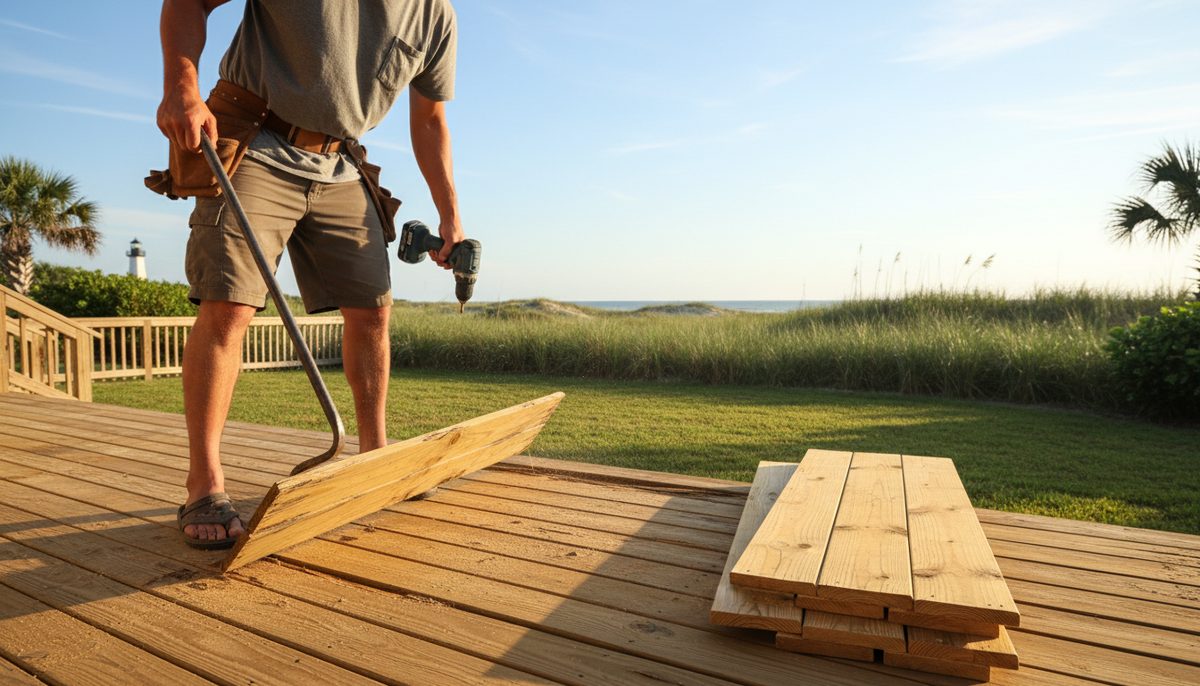
How much can a deck cost before you need a licensed contractor?
The $40,000 line: North Carolina's G.S. 87-1 licensing threshold for deck construction and repair, how projects cross it without looking like it, and what still applies below it.
The line, quoted from the statute
North Carolina answers this question with a single dollar figure, and it is a statute, not a rule of thumb. The G.S. 87-1 — $40,000 threshold rule — G.S. 87-1(a) — means anyone who undertakes, for a fixed price, commission, fee, or wage, to bid on or construct a building or improvement costing $40,000 or more is deemed a general contractor and must hold a state general contractor license. The number counts the whole undertaking: materials, labor, the complete scope, all of it. There is no per-trade carve-out and no "but it's only a deck" exception; a deck is a structure, and the statute prices the structure, not the label.
The county repeats the line, and adds the trades
Dare County does not soften it. NC licensed GC required at $40,000+: a North Carolina licensed general contractor is required for building construction or repairs costing $40,000 or more — and each contractor and subcontractor must possess a valid license issued by the State of North Carolina. The subcontractor clause is the part deck projects most need to hear, because a deck that crosses the line is rarely one trade's work. Framing, the electrical branch for lights and fans, whoever pours or resets footings: above the threshold, the license requirement follows every one of them onto the job, not just the name on the sign.
For an owner, that clause is also protection. A project large enough to trigger it is a project large enough that a state board stands behind the license supervising it — which is precisely what the legislature was pricing when it set the number.
How a deck crosses $40,000 without looking like it
Deck repair is where this threshold quietly bites, because repairs grow. A project that starts as "replace the failing boards" becomes sister the joists, becomes reset the footings that shifted, becomes a code-current railing because the old one no longer passes, becomes a rebuilt stair run to the new elevation. Nobody priced a $40,000 undertaking at the first conversation; the scope arrived there one change order at a time. The statute's test is the cost of the undertaking as undertaken — which is why a contractor who re-prices the accumulated scope against the licensing line before the change orders do is the contractor worth keeping.
And a split quote is not a loophole. Two invoices of $24,000 for one continuous project under one direction are one undertaking wearing two envelopes, and treating a licensing threshold as a billing puzzle is exactly the kind of creativity that leaves an owner holding unlicensed, unpermitted work with no board to call. If the total scope crosses the line, the honest move is the licensed one — the arithmetic was never the hard part.
Below the line — what still applies
A deck project under $40,000 escapes the licensing gate and inherits everything else. The county's plan requirement still reads Three sets of plans for new construction; the close-out still runs through Final inspection precedes permanent power, with permanent power waiting on approved finals; and on a lot fronting the water, CAMA permit may be required on waterfront still stacks the CAMA review on top of the building permit at its published CAMA minor permit fee $119 (July 1, 2025) minor-permit price. Licensing is the only gate on this list keyed to the project's cost — the rest key to the project's existence.
The owner-builder door, and its condition
There is a statutory path around the licensing requirement — the G.S. 87-1(b)(2) owner-builder exemption — and it opens only for an owner building on land they own, for occupancy by that owner and their family, in compliance with G.S. 87-14. It carries a presumption with teeth: if the building is not occupied solely by that owner for at least twelve months after completion, the exemption is presumed not to have applied. A deck built under the exemption and a house listed for weekly renters the following June are two facts that sit badly together, and the presumption exists precisely because the legislature knew they would.
For a genuine owner-occupant doing genuine owner-occupant work, the exemption is real and we are not the ones to talk anyone out of it. What we will say is that the projects the exemption does not cover — a rental's big rebuild, a flip, a friend's cousin paid in cash — are the projects that should have had a license from the first footing.
Tell us the scope you actually have in mind — boards, rail, stairs, lights, the whole of it — and we will tell you honestly which side of $40,000 it lands on and who is therefore allowed to build it.
On the record: G.S. 87-1 — $40,000 threshold (N.C. General Statutes 87-1 — 'General contractor' defined; exceptions (ncleg.gov, retrieved 2026-09-17)) · NC licensed GC required at $40,000+ (Dare County — Building Permits & Inspections (darenc.gov, retrieved 2026-09-17)) · CAMA minor permit fee $119 (July 1, 2025) (Dare County — CAMA (darenc.gov, retrieved 2026-09-17))
Hand-verified 2026-09-17 against the primary sources named above; where a fact could not be verified it was left out, never guessed.