Outer Banks septic guide
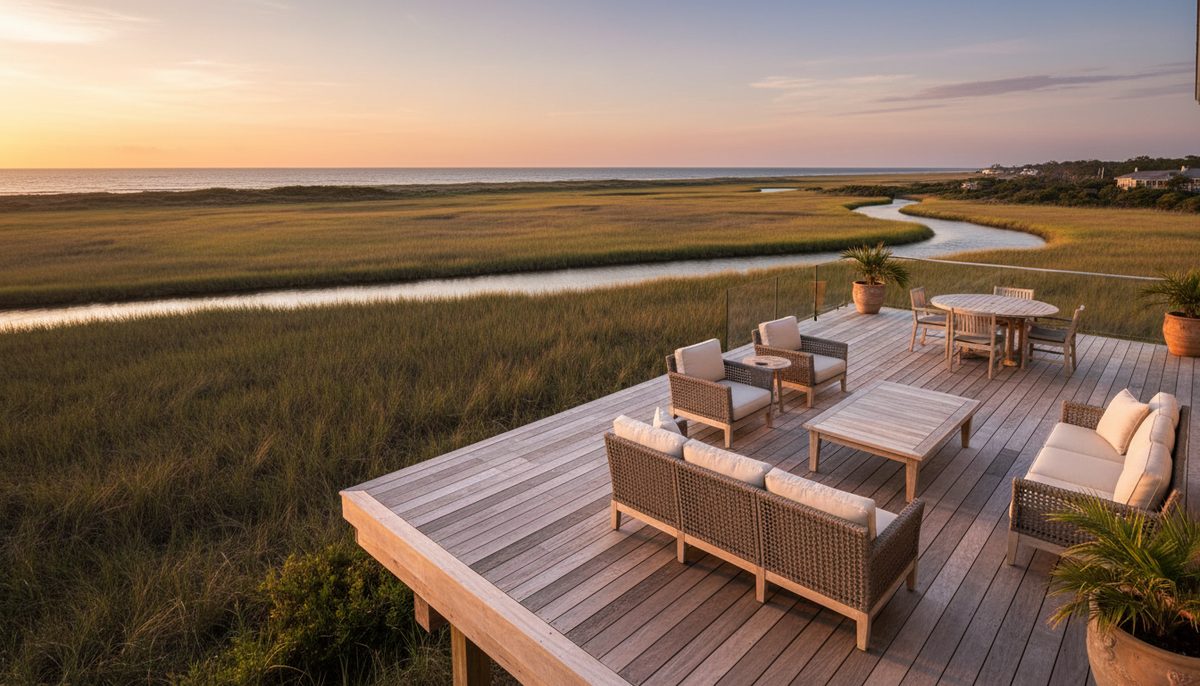
How far back from the ocean can you build a deck in North Carolina?
North Carolina's oceanfront construction setback is 60 feet or 30 times the erosion rate, whichever is greater — built from 50+ years of shoreline data. What that means for a deck.
The honest answer is that there is no single distance — there is a calculation, and your lot's number comes out of it. The state's oceanfront construction setback is the greater of a fixed distance and a multiple of your shoreline's erosion rate, which means two oceanfront lots a mile apart can carry genuinely different buildable lines.
The details
The rule itself. Oceanfront setback: 60 ft or 30× erosion rate: under the Coastal Resources Commission's oceanfront rules, a building or structure under 5,000 square feet must sit landward of a minimum setback of 60 feet or 30 times the long-term average annual shoreline erosion rate — whichever is greater. Larger structures face the steeper version: 60 times the erosion rate or 120 feet, whichever is greater. A deck is a structure under this rule, not an accessory afterthought, and on a high-erosion stretch the multiplied number is the one that governs.
Where the multiplier comes from matters, because it explains why the rule feels arbitrary until you see the data behind it. Setback based on 50+ year erosion data: North Carolina's setback factors are built from long-term — fifty years and more — average annual shoreline change rates, which the Division of Coastal Management uses to establish the published setback factors and the Ocean Erodible Areas of Environmental Concern. The line on your lot is not a guess drawn by a planner; it is a half-century of measured movement of the beach itself, converted into a distance a structure is required to respect.
What that means for a deck owner is three practical things. First, the neighbor's deck is not evidence — the erosion rate is computed per shoreline segment, so his buildable line and yours can differ. Second, the deck obeys the same setback math as the house, which matters on lots where the house was built hard against its own line and the deck wants to run forward. Third, the specific factor for your stretch of shoreline is published, and the Local Permit Officer can read it to you — this is a data question with a data answer, not a negotiation.
And a deck that clears the setback still needs its permit. An oceanfront lot is inside an AEC, so the CAMA minor permit fee $119 (July 1, 2025) applies for the minor development permit that the deck will need alongside whatever the county requires — a fixed, published fee for the review that decides whether your calculated line and your plan agree.
Do not pace the beach with a tape measure and hope — call the Local Permit Officer, get your segment's setback factor, and let the arithmetic say where the deck may stand before the design assumes it.
On the record: Oceanfront setback: 60 ft or 30× erosion rate (NC DEQ Division of Coastal Management — Oceanfront Construction Setback & Erosion Rates; DCM memorandum CRC-16-42, Amendments to 15A NCAC 7H .1300 (deq.nc.gov / files.nc.gov, retrieved 2026-09-17)) · Setback based on 50+ year erosion data (NC DEQ Division of Coastal Management — Oceanfront Construction Setback & Erosion Rates (deq.nc.gov, retrieved 2026-09-17)) · CAMA minor permit fee $119 (July 1, 2025) (Dare County — CAMA (darenc.gov, retrieved 2026-09-17))
Hand-verified 2026-09-17 against the primary sources named above; where a fact could not be verified it was left out, never guessed.